
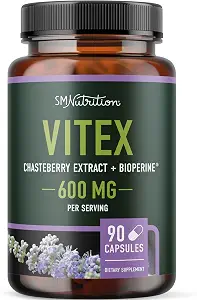
Vitex agnus-castus, commonly called chasteberry or chaste tree, stands out from most botanical ingredients — it has a genuinely substantial body of clinical research behind it, including multiple systematic reviews and meta-analyses specifically examining its effects on premenstrual syndrome (PMS) and related hormonal symptoms. This SMNutrition formula delivers 600mg per serving in a gluten-free, vegetarian capsule.
Who This Product Is For
This is aimed at women experiencing PMS symptoms — mood swings, irritability, breast tenderness, bloating — who want to try a well-studied herbal option. It is not appropriate for anyone who is pregnant, and anyone on hormonal birth control, dopaminergic medications, or with a hormone-sensitive condition should talk to a doctor before use, given chasteberry's real mechanism of action on dopamine receptors and prolactin levels.
Features Explained
| Feature | Detail |
| Format | Capsules, 600mg per serving |
| Supply | 90 capsules, 3-month supply |
| Formula claims | Certified gluten-free, vegetarian |
| Marketed benefits | Hormone balance, menopause support, menstrual regularity, hormonal acne |
The evidence base — genuinely one of the stronger ones: A 2017 comprehensive review identified 17 randomized controlled trials of chasteberry for PMS/PMDD, with 13 of 14 trials in one meta-analysis showing positive improvements in total premenstrual symptoms. Germany's Commission E has formally approved Vitex agnus-castus specifically for menstrual cycle irregularities, premenstrual symptoms, and cyclic breast pain. Some reviews describe chasteberry's effectiveness for PMS as comparable to fluoxetine (an antidepressant) or vitamin B6 in head-to-head research, generally with a more favorable side-effect profile.
How it actually works: Chasteberry acts on dopamine receptors in the pituitary gland, which in turn influences prolactin levels — a reasonably well-understood mechanism, and exactly why the medication-interaction cautions matter.
What the evidence doesn't establish: The "hormonal acne" and general "menopause support" claims have less direct trial support than the PMS/PMDD and cyclic breast pain findings specifically.
Pros
- Genuinely one of the more substantially evidenced botanical ingredients available, backed by multiple systematic reviews and meta-analyses
- Formally approved by Germany's Commission E for menstrual and premenstrual symptom relief
- Some research suggests effectiveness comparable to a prescription antidepressant for PMS symptoms
- Reasonably well-understood mechanism of action
- Gluten-free, vegetarian, standard 3-month supply
Cons
- Not appropriate during pregnancy
- Genuine interaction potential with hormonal birth control and dopaminergic medications
- "Hormonal acne" and broader "menopause support" claims have less direct trial support than the PMS/PMDD-specific findings
- Effects typically take a full cycle or more to become apparent
- Statements have not been evaluated by the FDA
Performance
Chasteberry is genuinely more likely to produce a real, noticeable effect on PMS symptoms — particularly mood-related symptoms, breast tenderness, and bloating — than most botanicals. One frequently cited trial found 52% of women taking chasteberry experienced at least a 50% symptom reduction, compared to 24% on placebo. Expect results to develop over one or more menstrual cycles.
FAQs
Does chasteberry actually work for PMS? Based on multiple systematic reviews and meta-analyses, yes — this is genuinely one of the better-evidenced herbal ingredients for PMS/PMDD symptom relief.
How long does it take to work? Give it at least one full menstrual cycle, and often longer, before evaluating whether it's helping.
Can I take this with birth control? Talk to a doctor first — chasteberry's dopamine/prolactin mechanism means it can genuinely interact with hormonal contraceptives.
Is it safe during pregnancy? No — its real hormonal mechanism makes chasteberry inappropriate during pregnancy without specific medical guidance.
Verdict
Chasteberry is genuinely one of the better-evidenced botanical ingredients covered anywhere in this category, with a substantial base of systematic reviews and meta-analyses supporting real PMS and premenstrual symptom relief. For PMS symptom relief specifically, this is one of the stronger recommendations available.